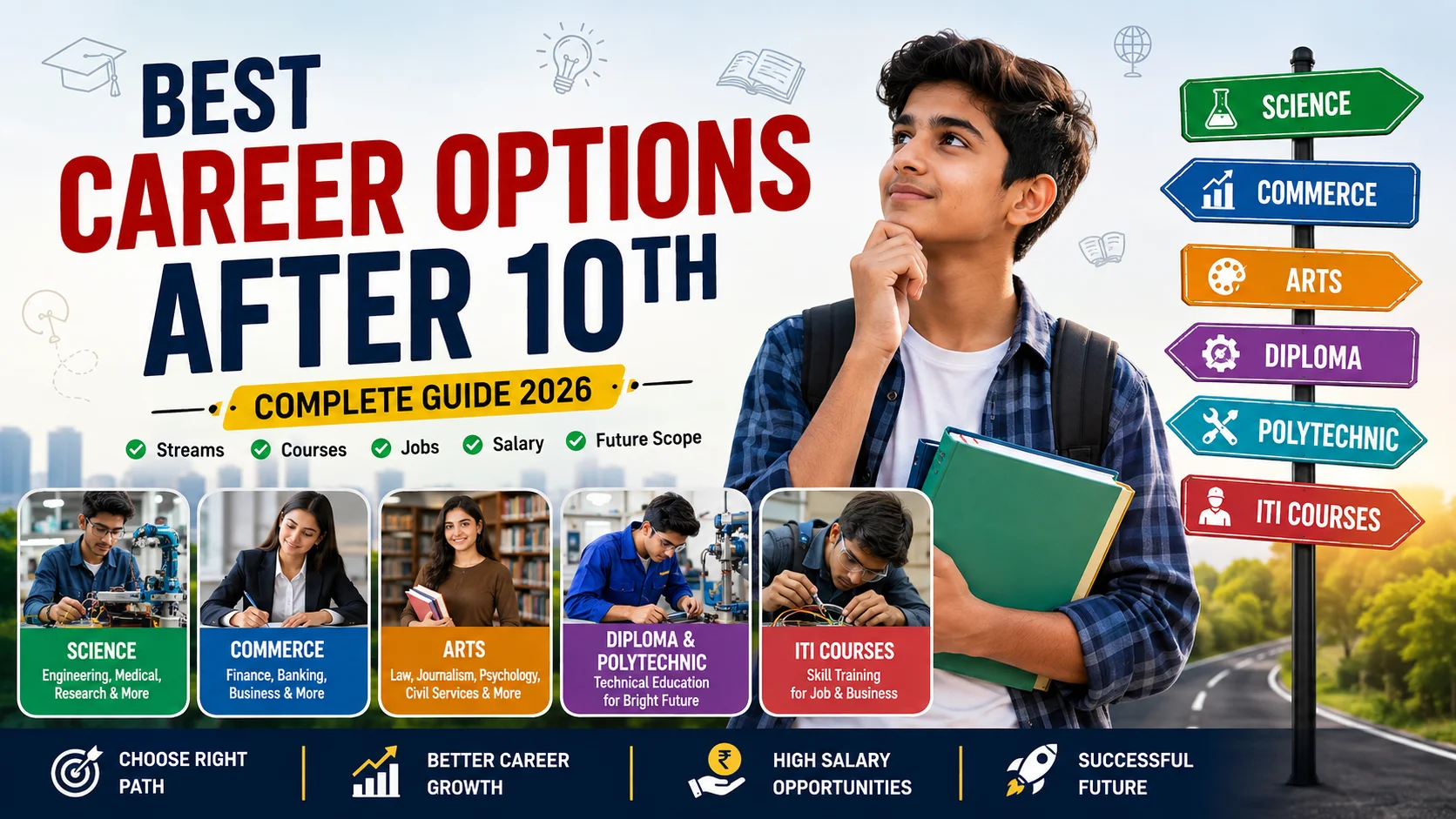
Best Career Options After 10th in India
Choosing the right career after Class 10 is one of the most important decisions in a student’s life. The stream or course you select today can influence your higher education, career opportunities, and long-term growth. Many students feel confused because there are several options available, including Science, Commerce, Arts, Diploma, ITI, Polytechnic, and skill-based courses.
The best career option depends on your interests, strengths, career goals, and learning style. Instead of following friends or family trends, students should understand every available option before making a decision.
In this guide, you’ll learn about the best career options after the 10th, eligibility, career scope, salary expectations, and tips to choose the right path.
Why Choosing the Right Career After 10th is Important
Your decision after Class 10 lays the foundation for your future education and profession. A well-informed choice can help you:
- Build a strong academic foundation.
- Choose a career aligned with your interests.
- Improve long-term earning potential.
- Reduce the chances of changing streams later.
- Stay motivated throughout your studies.
Before selecting any stream or course, ask yourself these questions:
- Which subjects do I enjoy the most?
- What kind of work excites me?
- Do I prefer practical learning or theory?
- What are my long-term career goals?
If you need help choosing the right education path, contact our education team for guidance.
Best Career Options After 10th
Students generally have six major career paths after completing Class 10:
| Career Option | Best For | Higher Education |
|---|---|---|
| Science | Engineering, Medical, Research | B.Tech, MBBS, B.Sc |
| Commerce | Business, Finance, Banking | B.Com, CA, CS, MBA |
| Arts | Civil Services, Law, Journalism | BA, LLB, MA |
| Polytechnic | Technical Careers | B.Tech (Lateral Entry) |
| ITI | Skilled Trades | Employment / Diploma |
| Skill Courses | Digital Careers | Certifications |
Science Stream After 10th
Science is considered one of the most popular streams because it offers a wide range of career opportunities. Students interested in Mathematics, Physics, Chemistry, Biology, or Computer Science often choose this stream.
The Science stream is ideal for students who enjoy problem-solving, analytical thinking, and practical learning.
Subjects in Science Stream
- Physics
- Chemistry
- Mathematics
- Biology (optional depending on PCM/PCB)
- Computer Science
- English
Students can choose between:
PCM (Physics, Chemistry, Mathematics) – suitable for Engineering, Architecture, Data Science, Artificial Intelligence, Defence, and Technology.
PCB (Physics, Chemistry, Biology) – suitable for Medical, Pharmacy, Nursing, Biotechnology, and Allied Health Sciences.
PCMB – keeps both engineering and medical pathways open but has a heavier academic workload.
Career Options After Choosing Science
Engineering
Engineering remains one of the most sought-after career options. Students who study PCM can prepare for entrance exams such as JEE Main and JEE Advanced and later pursue B.Tech or BE programs in branches like:
- Computer Science Engineering
- Artificial Intelligence & Machine Learning
- Mechanical Engineering
- Civil Engineering
- Electronics & Communication
- Electrical Engineering
Students interested in engineering can explore colleges to compare higher education options, courses, and admission opportunities.
Future Scope
Graduates can work in IT companies, manufacturing, construction, research, automotive, and government organizations. Emerging fields like AI, robotics, cybersecurity, and renewable energy are creating new opportunities.
Average Salary
- Fresher: ₹3–8 LPA (varies by college, skills, and role)
- Experienced professionals can earn significantly more as they grow in their careers.
Medical Careers
Students choosing PCB can prepare for medical entrance examinations and pursue careers in healthcare.
Popular medical courses include:
- MBBS
- BDS
- BAMS
- BHMS
- B.Sc Nursing
- BPT (Physiotherapy)
- Pharmacy
- Biotechnology
Healthcare professionals continue to be in demand across hospitals, research institutions, public health organizations, and private practice.
Students looking for higher education options can explore colleges offering relevant medical and healthcare programs.
Average Salary
Entry-level salaries vary widely depending on the profession, qualifications, and employer, with strong long-term career growth in many healthcare fields.
Computer Science & Technology
Technology careers are among the fastest-growing in India and globally. Students interested in coding and innovation can build careers in:
- Software Development
- Artificial Intelligence
- Machine Learning
- Cybersecurity
- Data Science
- Cloud Computing
- Game Development
- Mobile App Development
Even while studying in Class 11 and 12, students can start learning programming languages like Python or JavaScript and build projects to strengthen their skills.
Defence Services
Science students also have opportunities to prepare for defence careers through pathways such as the National Defence Academy (NDA) after meeting the required eligibility criteria.
Potential career paths include:
- Indian Army
- Indian Navy
- Indian Air Force
These careers offer structured training, leadership opportunities, and long-term career progression.
Advantages of Choosing Science
- Wide range of career options.
- Opportunity to switch to Commerce or some interdisciplinary fields later (subject to eligibility).
- High demand in technology and healthcare sectors.
- Strong foundation for research and innovation.
- Opportunities in both India and abroad.
Is Science the Right Choice for You?
Science may be a good fit if you:
- Enjoy Mathematics or Biology.
- Like solving logical problems.
- Are curious about technology or medicine.
- Are comfortable with a rigorous academic workload.
- Plan to pursue engineering, medical, research, or technology-related careers.
Commerce Stream After 10th
Commerce is one of the best career options for students who are interested in business, finance, economics, banking, accounting, taxation, entrepreneurship, and management. Contrary to a common myth, Commerce is not only about becoming an accountant—it opens doors to many high-paying careers in India and abroad.
With the rapid growth of startups, e-commerce, fintech, digital payments, and global businesses, Commerce professionals are in high demand.
Subjects in Commerce Stream
Most schools offer the following subjects:
- Accountancy
- Business Studies
- Economics
- Mathematics (Optional but recommended)
- English
- Informatics Practices / Computer Science (Optional)
Students who choose Mathematics along with Commerce often have more career opportunities in finance, data analytics, and management.
Best Career Options After Choosing Commerce
Chartered Accountant (CA)
CA is one of India’s most respected professional qualifications. Chartered Accountants manage taxation, auditing, financial reporting, and corporate finance.
Career Opportunities
- Chartered Accountant
- Tax Consultant
- Auditor
- Financial Advisor
- CFO (Chief Financial Officer)
- Independent Practice
Skills Required
- Analytical Thinking
- Mathematics
- Problem Solving
- Attention to Detail
Company Secretary (CS)
A Company Secretary ensures legal compliance, corporate governance, and regulatory filings for companies.
Career Scope
CS professionals work with:
- Listed Companies
- MNCs
- Government Organizations
- Legal Firms
- Private Companies
Cost & Management Accountant (CMA)
CMA professionals help organizations manage budgets, costs, pricing, and business profitability.
Demand for CMAs is increasing in manufacturing companies, MNCs, and consulting firms.
Banking & Finance
Commerce students can build careers in:
- Banking
- Investment Banking
- Stock Market
- Insurance
- Financial Planning
- Mutual Funds
- Wealth Management
Popular degrees include:
- B.Com
- BBA
- BMS
- Bachelor of Economics
Students interested in Commerce and finance can explore colleges offering relevant programs and compare courses, locations, and admission options.
Advantages of Arts Stream
- Wide career choices
- Suitable for creative students
- Opportunities in government jobs
- Growing demand for psychologists and designers
- Flexibility to pursue diverse higher education programs
Diploma Courses After 10th
Students who want practical, career-oriented education can choose diploma programs after Class 10. These courses usually take 2–3 years and focus on industry-relevant skills.
Popular diploma options include:
- Diploma in Computer Engineering
- Diploma in Mechanical Engineering
- Diploma in Civil Engineering
- Diploma in Electrical Engineering
- Diploma in Electronics Engineering
- Diploma in Automobile Engineering
- Diploma in Fashion Design
- Diploma in Interior Design
- Diploma in Hotel Management
- Diploma in Pharmacy (eligibility varies by institution and regulations)
Many diploma graduates later take lateral entry admission into engineering degree programs, depending on eligibility and institute rules.
Students can explore colleges to compare diploma and higher education opportunities.
Polytechnic Courses After 10th
Polytechnic education provides technical knowledge and hands-on training.
Popular branches include:
- Computer Engineering
- Mechanical Engineering
- Civil Engineering
- Electrical Engineering
- Electronics
- Information Technology
Benefits of Polytechnic
- Lower fees compared to many degree programs
- Practical learning
- Faster entry into technical jobs
- Opportunity for lateral entry into B.Tech (where applicable)
Students planning their technical education can explore colleges and compare relevant courses and admission opportunities.
Science vs Commerce vs Arts
| Feature | Science | Commerce | Arts |
|---|---|---|---|
| Best For | Engineering, Medical | Finance, Business | Law, UPSC, Creative Careers |
| Difficulty | High | Moderate | Moderate |
| Career Options | Very Wide | Wide | Wide |
| Higher Studies | B.Tech, MBBS, B.Sc | B.Com, BBA, CA | BA, LLB, MA |
| Flexibility | High | High | High |
Which Stream Should You Choose?
Choose Science if:
- You enjoy Mathematics or Biology.
- You want to become an engineer, doctor, or researcher.
- You are interested in technology or healthcare.
Choose Commerce if:
- You like numbers, business, or finance.
- You want to become a CA, CS, CMA, banker, or entrepreneur.
- You are interested in economics and management.
Choose Arts if:
- You enjoy social sciences, languages, or creativity.
- You are interested in law, civil services, psychology, media, or design.
- You prefer analytical and communication-focused careers.
ITI Courses After 10th
Industrial Training Institute (ITI) is an excellent option for students who want to quickly develop practical skills and start a job or self-employment. ITI courses generally take 1–2 years and are available in both Government and Private institutes.
Top ITI Courses After 10th
| ITI Trade | Duration | Career Opportunities |
|---|---|---|
| Electrician | 2 Years | Electrical Companies, Government Departments |
| Fitter | 2 Years | Manufacturing Industries |
| Welder | 1 Year | Construction & Industrial Projects |
| COPA (Computer Operator & Programming Assistant) | 1 Year | IT Support, Data Entry, Office Automation |
| Diesel Mechanic | 1 Year | Automobile Workshops |
| Motor Mechanic | 2 Years | Automobile Industry |
| Plumber | 1 Year | Construction Companies |
| Refrigeration & Air Conditioning | 2 Years | AC & HVAC Industry |
| Electronics Mechanic | 2 Years | Electronics Companies |
| Draughtsman (Civil/Mechanical) | 2 Years | Construction & Design Firms |
Benefits of ITI
- Low course fees
- Practical training
- Faster job opportunities
- Government apprenticeship programs
- Opportunity to start your own business
Students looking for skill-based training and professional education can explore coaching and training institutes.
Government Jobs After 10th
If you want to build a career in the Government sector, there are several opportunities available even after Class 10.
Popular Government Job Options
- Indian Railways
- India Post (Postal Department)
- Indian Army (Soldier GD – eligibility as per recruitment notification)
- Indian Navy (certain entry schemes as notified)
- Indian Air Force (specific recruitment entries)
- Police Constable (State-wise)
- Forest Guard
- Multi-Tasking Staff (MTS)
- Home Guard
- State Government Recruitment
Note: Eligibility, age limit, and educational qualification vary according to each recruitment notification. Always check the official notification before applying.
Skill-Based Courses After 10th
In today’s digital world, traditional degrees are not the only important pathway. Practical skills are also highly valuable.
In-Demand Skill Courses
- Digital Marketing
- Graphic Design
- UI/UX Design
- Video Editing
- Web Development
- App Development
- Artificial Intelligence Basics
- Data Analytics
- Cyber Security
- Content Writing
- SEO (Search Engine Optimization)
- Social Media Marketing
These skills can also be useful for freelancing, remote jobs, and startup opportunities.
Students can explore coaching and training institutes for professional and skill-based courses.
High Salary Career Options After 10th (Long-Term)
These careers do not start directly after Class 10, but choosing the right stream and higher education can help students build a career in these fields with strong earning potential.
| Career | Recommended Path |
|---|---|
| Doctor | 10th → PCB → MBBS |
| Software Engineer | 10th → PCM → B.Tech |
| Chartered Accountant | 10th → Commerce → CA |
| Data Scientist | 10th → PCM → B.Tech/B.Sc |
| Lawyer | 10th → Arts/Commerce/Science → BA LLB/LLB |
| Pilot | 10th → PCM → Flight Training |
| Architect | 10th → PCM → B.Arch |
| AI Engineer | 10th → PCM → Computer Science |
| Cyber Security Expert | 10th → Science/Commerce → IT Courses |
| Digital Marketing Specialist | Any Stream + Professional Skills |
Career Comparison Table
| Option | Duration | Job Opportunities | Higher Studies |
|---|---|---|---|
| Science | 2 Years (11–12) | Excellent | B.Tech, MBBS, B.Sc |
| Commerce | 2 Years (11–12) | Excellent | B.Com, BBA, CA |
| Arts | 2 Years (11–12) | Excellent | BA, LLB, MA |
| Polytechnic | 3 Years | Very Good | Lateral Entry B.Tech |
| ITI | 1–2 Years | Good | Apprenticeship / Diploma |
| Skill Courses | 3–12 Months | Depends on Skills | Certifications & Advanced Courses |
How to Choose the Right Career After 10th
When choosing a career, do not depend only on salary or other people’s advice. Consider these factors:
1. Interest
Students who are interested in a subject generally have better chances of achieving long-term success in that field.
2. Strengths
Focus on your academic strengths—Maths, Biology, Communication, Creativity, or Technical Skills.
3. Career Goals
Think about the field you want to work in in the future.
4. Future Demand
Growth opportunities are increasing in sectors such as AI, Healthcare, Renewable Energy, Data Science, Cyber Security, and Digital Marketing.
5. Financial Planning
Consider course fees, scholarship options, and long-term education costs.
Common Mistakes Students Make After 10th
❌ Choosing a stream by looking at friends.
❌ Making a decision under parental pressure.
❌ Not researching career options.
❌ Selecting a stream only based on salary.
❌ Ignoring your interests and aptitude.
❌ Not taking professional career counselling.
Career Planning Checklist
✔ Identify your interests.
✔ Compare the syllabus of different streams.
✔ Research career options.
✔ Check college and course eligibility.
✔ Get information about entrance examinations.
✔ Explore scholarships and financial aid options.
✔ Discuss your plans with parents and teachers.
✔ If required, seek guidance from a certified career counsellor.
Conclusion
Choosing the right career after Class 10 is one of the first major decisions in your academic journey. Whether you select Science, Commerce, Arts, ITI, Polytechnic, or a diploma course, success depends on choosing a path that matches your interests, strengths, and long-term goals.
Take time to research different options, understand future opportunities, and avoid making decisions based only on peer pressure or trends. Building strong skills, staying consistent, and continuing to learn will help you succeed regardless of the stream you choose.
Students can explore schools, colleges, coaching institutes, hostels, and study abroad opportunities to plan their education journey.
For personalized education assistance, contact our team and get the right guidance for your next academic step.
What are the best career options after 10th?
The best career options after 10th include Science, Commerce, Arts, Polytechnic, ITI, Diploma courses, and skill-based programs. Students should choose a path based on their interests, strengths, and future career goals rather than following trends or others’ decisions.
2. Strengths
Focus on your academic strengths—Maths, Biology, Communication, Creativity, or Technical Skills.
3. Career Goals
Think about the field you want to work in in the future.
4. Future Demand
Growth opportunities are increasing in sectors such as AI, Healthcare, Renewable Energy, Data Science, Cyber Security, and Digital Marketing.
5. Financial Planning
Consider course fees, scholarship options, and long-term education costs.
Common Mistakes Students Make After 10th
❌ Choosing a stream by looking at friends.
❌ Making a decision under parental pressure.
❌ Not researching career options.
❌ Selecting a stream only based on salary.
❌ Ignoring your interests and aptitude.
❌ Not taking professional career counselling.
Career Planning Checklist
✔ Identify your interests.
✔ Compare the syllabus of different streams.
✔ Research career options.
✔ Check college and course eligibility.
✔ Get information about entrance examinations.
✔ Explore scholarships and financial aid options.
✔ Discuss your plans with parents and teachers.
✔ If required, seek guidance from a certified career counsellor.
Frequently Asked Questions (FAQs)
1. Which stream is best after 10th?
There is no single “best” stream for every student. If you’re interested in technology or medicine, Science may be suitable. If you enjoy business and finance, Commerce is a strong option. If you’re passionate about law, civil services, psychology, media, or creative fields, Arts can be the right choice.
If you are still confused about which stream or course to choose, get career guidance from our education team.
2. What are the best career options after 10th?
Some popular career paths include:
- Science
- Commerce
- Arts
- Polytechnic
- ITI
- Diploma Courses
- Skill Development Programs
- Defence Careers
- Government Jobs (as per eligibility)
Students can explore colleges, coaching institutes, and other education options based on their chosen career path.
3. Can I get a government job after 10th?
Yes. Various government departments recruit 10th-pass candidates for certain positions, depending on eligibility and recruitment notifications. Always check the official notification before applying.
4. Which diploma course is best after 10th?
Popular diploma courses include:
- Computer Engineering
- Civil Engineering
- Mechanical Engineering
- Electrical Engineering
- Automobile Engineering
- Interior Design
- Hotel Management
The right choice depends on your interests and career goals. You can also explore colleges offering relevant diploma and technical programs.
5. Is ITI better than 12th?
ITI and Class 11–12 serve different purposes.
- ITI focuses on practical skills and quicker entry into technical jobs.
- Class 11–12 is generally preferred if you plan to pursue graduation such as B.Tech, MBBS, B.Com, BA, or similar degree programs.
Choose the option that aligns with your future plans.
6. Which stream has the highest salary potential?
Long-term earning depends more on your skills, experience, and profession than the stream itself. Science, Commerce, and Arts all offer high-paying career opportunities.
7. Can Commerce students become IAS officers?
Yes. Students from any recognized stream can prepare for civil services after completing the required graduation and meeting the eligibility criteria.
8. Can Arts students become lawyers?
Yes. Arts students can pursue integrated law programs (such as BA LLB) or LLB after graduation, subject to eligibility.
9. What skills should students learn after 10th?
Useful skills include:
- Communication
- Computer Skills
- Coding Basics
- Digital Marketing
- Graphic Design
- English Speaking
- Problem Solving
- Critical Thinking
- AI Literacy
Students can explore skill-based courses and training programs to develop practical knowledge alongside their academic education.
10. How do I choose the right career after 10th?
Consider:
- Your interests
- Your strengths
- Long-term goals
- Course eligibility
- Career opportunities
- Future industry demand
If needed, seek guidance from teachers or qualified career counsellors. You can also contact our education team for guidance.
Conclusion
Choosing the right career after Class 10 is one of the first major decisions in your academic journey. Whether you select Science, Commerce, Arts, ITI, Polytechnic, or a diploma course, success depends on choosing a path that matches your interests, strengths, and long-term goals.
Take time to research different options, understand future opportunities, and avoid making decisions based only on peer pressure or trends. Building strong skills, staying consistent, and continuing to learn will help you succeed regardless of the stream you choose.
Students can explore schools, colleges, coaching institutes, hostels, and study abroad opportunities to plan their education journey.
For personalized education assistance, contact our team and get the right guidance for your next academic step.
What are the best career options after 10th?
The best career options after 10th include Science, Commerce, Arts, Polytechnic, ITI, Diploma courses, and skill-based programs. Students should choose a path based on their interests, strengths, and future career goals rather than following trends or others’ decisions.